




Synopsis
Prologue
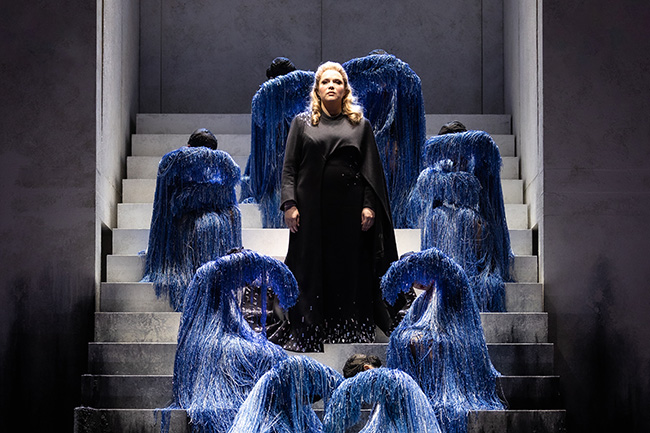
An ancient figure appears in the darkness, full of rage and fear. It is the royal ancestress Lou-Ling. Another figure wraps her arms around her and calms the spirit. It is the fierce and loyal Princess Turandot.
ACT I
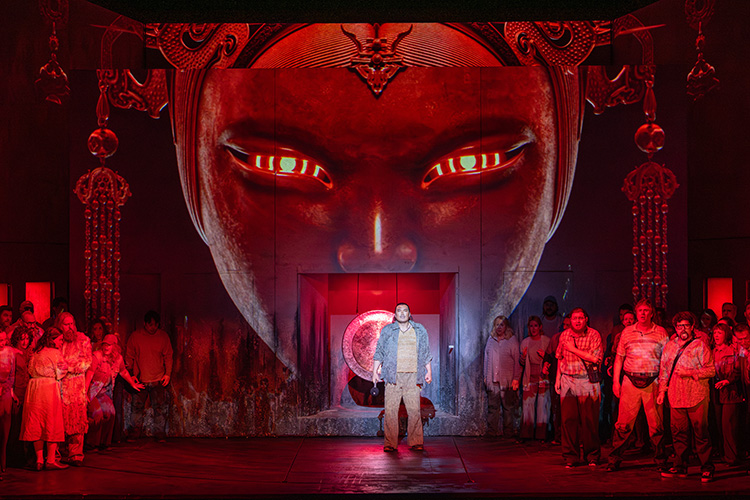
At sunset, the Speaker appears before the crowd and announces that anyone of royal blood seeking to marry the Princess Turandot must first answer three riddles. Failure equals death. The latest suitor, the Prince of Persia, has failed to solve the riddles and is to be executed at the moon’s rising. Surging forward, the ferocious crowd calls for blood, and an old blind man is knocked to the ground.
In response to his servant’s cries for help, a young man steps forward. The old man is Timur, the banished King of Tartary, who is overjoyed to learn that the young man is his long-lost son, Calaf. They fear for their lives, so Calaf’s name is not mentioned; he exists as the ‘Unknown Prince’. Timur tells his son that only his servant, Liù has remained faithful to him in his exile. Calaf asks her why she has risked so much; she replies it is because once long ago he, Calaf, smiled at her.
As the sky darkens, the people again cry for blood and await the moon with sudden, fearful silence. They are further moved when the youthful Prince of Persia passes by and they call upon Turandot to spare him. Calaf curses the princess who sends such a young man to his death. She appears in her armoured and awesome form and bids the execution to proceed.
Calaf is transfixed by his first sight of the princess. As the Prince of Persia’s death cry is heard in the distance, he strides to the gong that announces a new suitor. Suddenly, the three men who make up Turandot’s Administration appear and attempt to discourage him. Timur and the tearful Liù also beg him to reconsider, but as their pleas intensify, so does his determination, and he calls Turandot’s name three times and strikes the fatal gong.
ACT II
At their headquarters, faced with another Riddle Ritual, Turandot’s three administrators prepare for different outcomes. Should the Unknown Prince succeed, a wedding, should he fail, a funeral. They think longingly of their distant country homes and lament this cyclical trap of trauma. They dream of a release, but the noise of the populace gathering jolts them back into reality.
The people, hungry for another ritual, have gathered in the square. Turandot’s father, the aged Emperor, wearily asks the Unknown Prince to reconsider. Turandot, powerful and protected, appears and describes how her noble ancestor, Princess Lou-Ling, was raped and murdered by a conquering prince. To honor her forgotten ancestor, who is the spirit figure who appears only to her, Turandot has vowed to reject all suitors so that none shall possess her, and none shall forget what happened to Lou-Ling.
Facing Calaf, she poses her first question: What is born each night and dies each dawn? “Hope” answers Calaf correctly. Unnerved, Turandot continues: What flickers red and warm like a flame, yet is not fire? “Blood” replies Calaf after a moment’s pause. Visibly shaken, Turandot delivers her third riddle: What is like ice but burns? A tense silence prevails until Calaf triumphantly cries, “Turandot!”
The crowd erupts in celebration at the solving of the riddles and Turandot’s self-composure and protection shatters. The princess begs her father not to give her to the stranger, but he is bound by an oath. Calaf, hoping to win her love, generously offers Turandot a challenge of his own: if she can learn his name by dawn, he will forfeit his life. Turandot accepts. The Emperor’s strength gives out and he dies.
ACT III
Calaf hears Turandot’s proclamation: on pain of death, no one in Peking shall sleep until Turandot learns the stranger’s name. He relies on his determination and love as he wills himself to win her hand. Desperate to avoid death, the three administrators try unsuccessfully to bribe him to leave the city. Fearing Turandot’s proclamation, the people drag in Liù and Timur. Horrified, Calaf tries to convince the people that neither knows his secret. When Turandot appears, commanding the dazed Timur to speak, Liù courageously cries out that she alone knows the stranger’s identity but will never reveal it. She is tortured but remains true. Impressed by such endurance, Turandot asks Liù’s secret: “Love,” she replies. To stop anyone from knowing Calaf’s name, in a decisive act, Liù grabs a weapon and takes her own life. The crowd, suddenly moved beyond their comprehension by her sacrifice, form a funeral procession, confused in their shame.
Turandot, vulnerable and alone, remains to confront Calaf. In their fierce debate of love and tears, and inspired by Liu’s sacrifice, Turandot releases everything she has built to protect herself and Lou-Ling, and kisses Calaf.
As the people hail the new Empress, Turandot triumphantly announces the stranger’s name: it is Love. The people exalt the power of love, light and life.